

Research Focus and Directions
Our laboratory focuses on the functional role of gametes as a key determinant of reproductive success, particularly in species with external fertilization. In such species, fertilization success depends largely on sperm quality and the ability of spermatozoa to reach the egg within a very short time window. Environmental conditions therefore play a crucial role in this process.
We currently investigate various aspects of sperm physiology before and during motility, which define the main directions of our research.
“We consider the gamete environment an active factor that can influence fertilization outcome.”
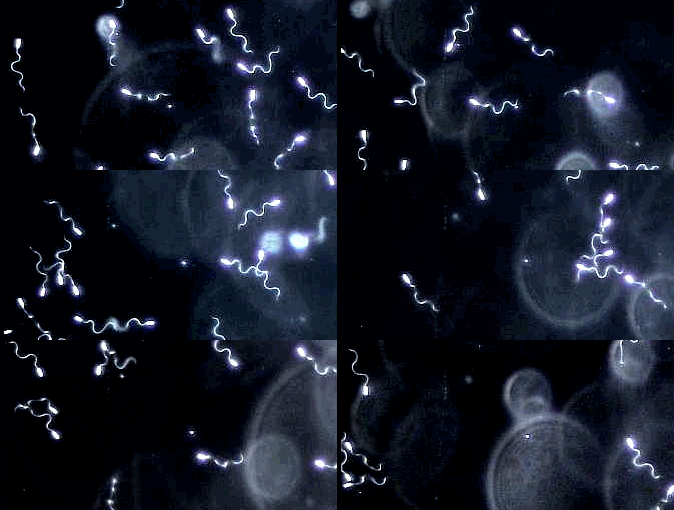
Sperm and Flagellar Movement
We observe and record sperm movement and flagellar wave formation across different species using a variety of microscopic techniques and video systems under controlled environmental conditions. The resulting recordings are analyzed using CASA systems and specialized software for visualization and quantitative assessment of movement parameters.

Regulation of Sperm Activation and Motility
Our research focuses on the mechanisms regulating sperm activation, motility duration, and adaptive movement under changing environmental conditions. We employ inhibitory analyses, cell volume measurements, and patch-clamp techniques. These approaches deepen our understanding of gamete physiology and support the optimization of artificial fertilization methods, while also clarifying how changes in aquatic environments affect natural fish reproduction.

Energy Metabolism and Sperm Energy Consumption
We monitor changes in energetic metabolites (e.g., ATP, ADP, CP) during activation, motility, and short-term sperm storage. Our approaches include biochemical and fluorescence-based assays, enzyme activity analyses, assessment of oxidative phosphorylation, and evaluation of mitochondrial function. These data help explain differences in motility duration and intensity and contribute to optimizing conditions for gamete storage and cryopreservation.

Guidance Mechanisms and Interaction with Ovarian Fluid and the Environment
Following activation, spermatozoa move within an environment that critically determines their ability to reach and fertilize the egg. In externally fertilizing species, ovarian fluid plays a key role by creating specific chemical and physical conditions that affect sperm speed, trajectory, motility duration, and flagellar function. Its components (ions, amino acids, proteins, and signaling molecules) modulate sperm physiology, including ionic balance and cellular signaling.
We quantify the effects of these components using video analysis, fluorescent markers, controlled-environment experiments, and fertilization assays. These findings enhance our understanding of natural sperm selection processes and support the optimization of artificial fertilization methods in aquaculture and conservation.

Cryopreservation and Gamete Storage
We focus on optimizing cryopreservation and short-term storage methods for sperm of various fish species. We test different types of cryoprotective solutions and extenders and evaluate their effects on sperm viability, motility, and fertilization capacity. Our work also includes developing protocols suitable for practical use, including standardization and optimization for large-scale processing and storage.


