

In many lakes and ponds around the world, excess nutrients—especially nitrogen and phosphorus—are accumulating. These nutrients often originate from agriculture and other human activities and can lead to algal blooms and declining water quality. Scientists typically study nutrient cycling by focusing on the basic chemical elements—carbon, nitrogen, and phosphorus. However, this approach may overlook an important part of the process: how organisms actually use nutrients through their diet.
In our study, we therefore propose a new perspective on nutrient cycling in aquatic ecosystems. Instead of focusing only on individual elements, we look at specific biomolecules that animals obtain from food, such as certain amino acids, lipids, or carbohydrates. We refer to these key “nutrient packages” as “Rings of Power.” These molecules can strongly influence how efficiently organisms convert food into their own biomass and how much nitrogen and phosphorus subsequently release back into the environment (Figure 1).
When organisms receive the right types of biomolecules in their diet, they can retain more nutrients in their bodies and excrete less waste. As a result, nutrient cycling can slow down and become more efficient. By combining insights from animal nutrition and food-web ecology, we can better understand how nutrients move through aquatic ecosystems and potentially influence these processes in a targeted way.
This approach also opens new possibilities for nature-based solutions to nutrient pollution. For example, by managing feeding relationships among organisms such as fish or zooplankton, it may be possible to retain more nutrients in biomass and reduce their availability for excessive algal growth. In nutrient-rich environments, such strategies could help mitigate eutrophication while supporting productive and sustainable aquaculture.
Our work therefore suggests that understanding which molecules organisms consume in their diet may be just as important as knowing how much nitrogen or phosphorus is present in the environment. Shifting the focus from individual chemical elements to biomolecules could provide new tools for protecting and restoring healthy aquatic ecosystems.
More detailed information can be found in the original scientific article:
Roy, K. and Mraz, J., 2026. The Rings of Power: managing nutrient cycles in aquatic food webs above and beyond primary producers. Web Ecology, 26(1), pp.27-33. https://doi.org/10.5194/we-26-27-2026
Financial support
The authors were financially supported during the preparation of this article by the Ministry of Education, Youth and Sports of the Czech Republic within the OP JAK program, project Aquaculture for Future (CZ.02.01.01/00/23_021/0012616). The first author further acknowledges support from the Visiting Scientist Fellowship program of WIAS (Wageningen Institute of Animal Sciences), which enabled his sabbatical stay and access to research resources that contributed to the conceptual development of this article.
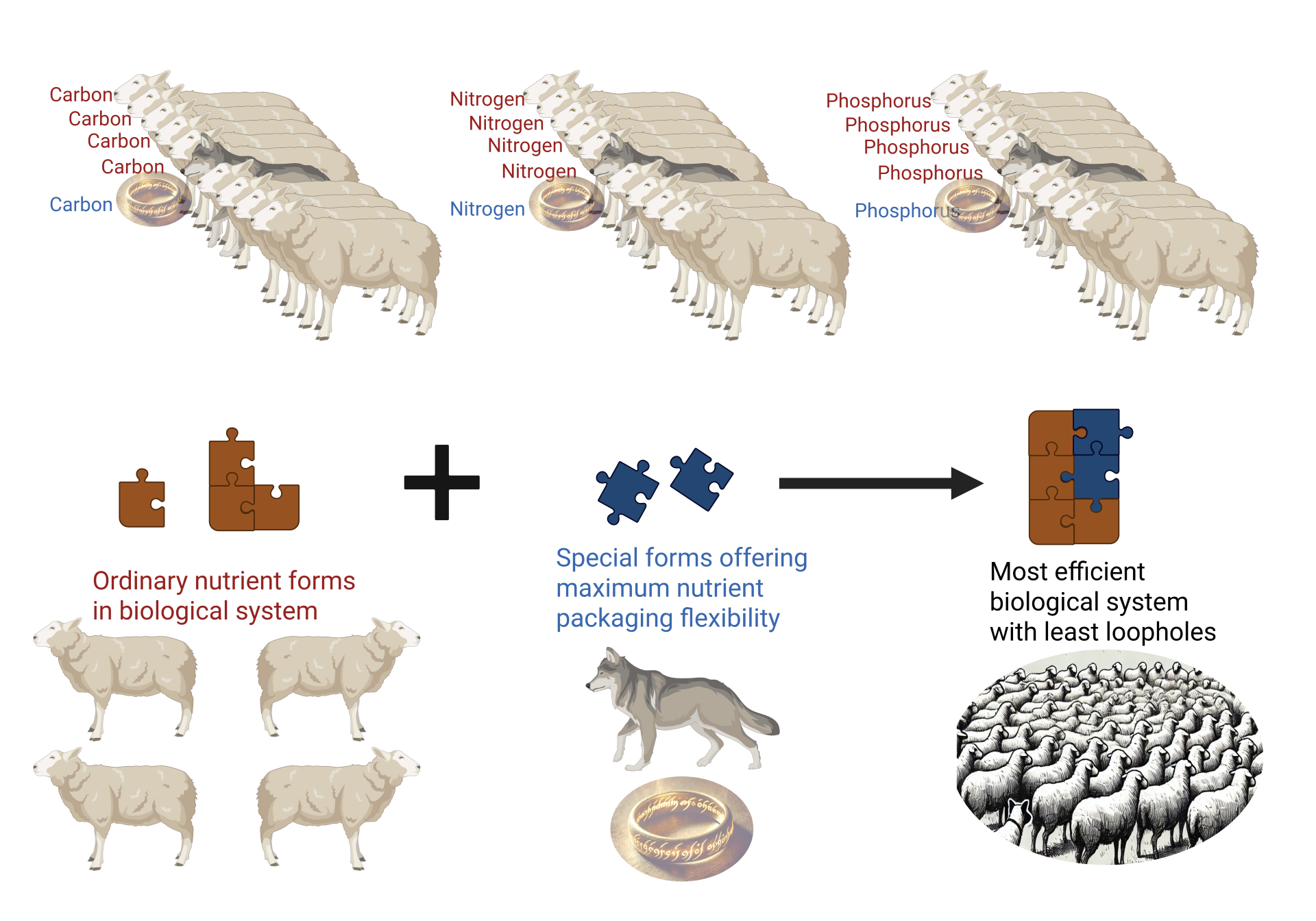
Figure 1: Rings of Power philosophy, metaphorically portrayed as a sheepdog (special biomolecules containing C, N, P) among sheep (average biomolecules containing C, N, P), holding the power to orchestrate maximum packaging of elements.


