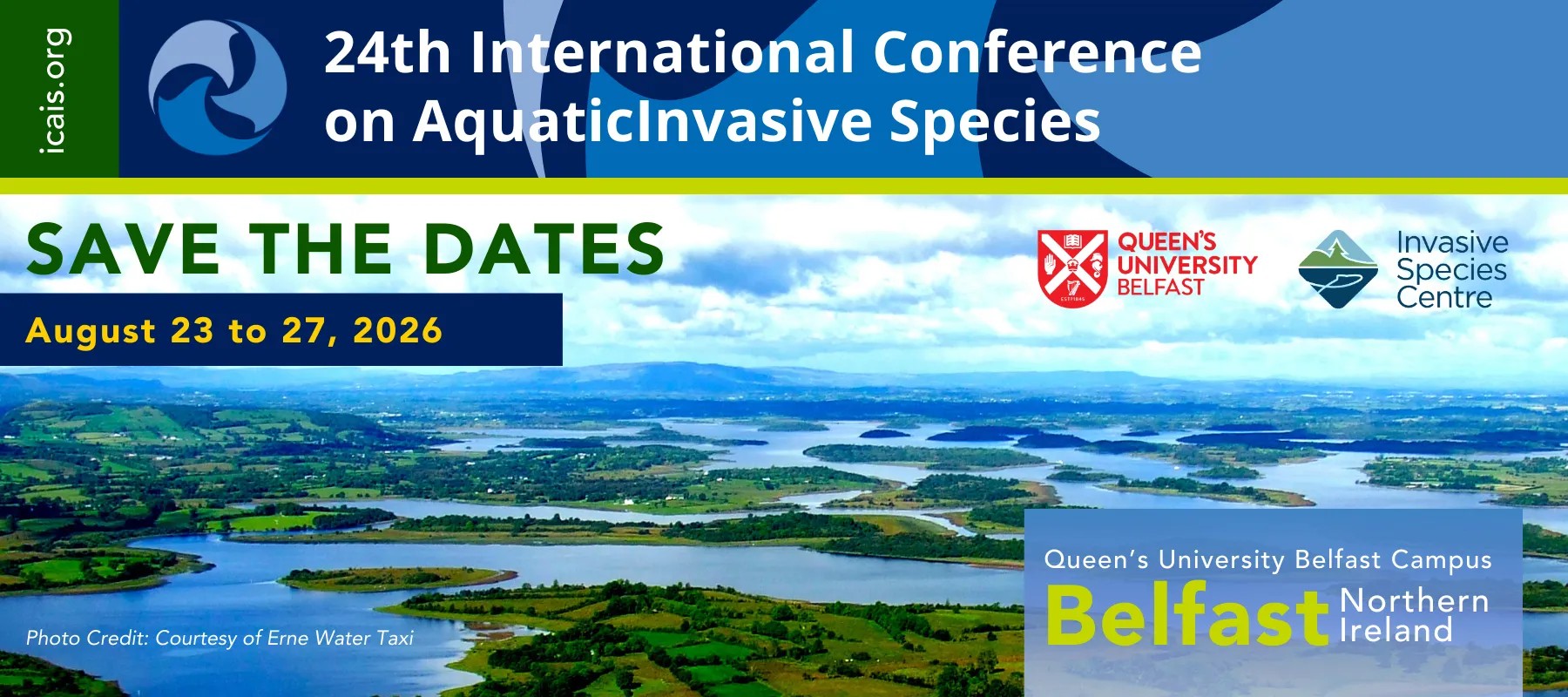

From 23 to 27 August 2026, Antonín Kouba, Miloš Buřič, Paride Balzani and Phillip Haubrock participated in the 24th International Conference on Aquatic Invasive Species (ICAIS 2026) in Belfast, Northern Ireland. The conference, held at Queen’s University Belfast, brought together more than 350 participants from over 40 countries.
Our Faculty was represented through several scientific contributions. Antonín Kouba’s contribution, “Year-round monitoring of the Oriental river prawn in Germany: insights into an emerging Danube invader,” focused on shrimp Macrobrachium nipponense, an emerging invasive species in European freshwaters. Year-round monitoring at Racklau harbour in Passau, the site of its first German record, showed that the species successfully overwinters and can reach considerable abundance and fecundity under Central European conditions. The findings suggest that the harbour may serve as a source population for further downstream spread.
Miloš Buřič addressed the practical and ethical challenges of managing large catches of invasive fish in a presentation titled “How can we humanely deal with the flood of caught invasive fish?” The contribution described the development of a mobile electric device for stunning and killing invasive fish directly at capture sites, reducing transport and escape risks while minimising animal suffering.
The contribution “Seasonal and spatial variability in trophic web structure in a thermal freshwater ecosystem,” by Paride Balzani and colleagues, examined trophic interactions between native and non-native invasive species along a thermal gradient of the Hévíz Lake, Hungary. Finally, Phillip Haubrock contributed “A global account of established non-native fish species,” presenting the Global Fish Invasion Database, which documents more than 1,500 established non-native fish species across 193 countries.
Overall, ICAIS 2026 provided valuable opportunities for scientific exchange, networking and strengthening international collaboration in aquatic invasion research and management.